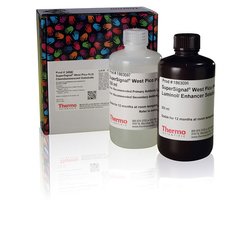
SuperSignal™ West Pico PLUS Chemiluminescent Substrate/化学发光底物
产品类型:免疫印迹/组化
Thermo Fisher
货号:34577 规格:200ml
货号:34578 规格: 1L
|
Thermo Scientific™ SuperSignal™ West Pico PLUS Chemiluminescent Substrate is an enhanced chemiluminescent (ECL) horseradish peroxidase (HRP) substrate that enables picogram- to high femtogram-level protein detection by western blot analysis.
SuperSignal West Pico PLUS substrate is designed to provide excellent signal intensity and sensitivity for western blotting with HRP conjugates. The intensity of the light emission combined with the exceptional duration allows for the acquisition of multiple exposures to more easily obtain publication-quality blot images. SuperSignal West Pico PLUS substrate is compatible with different membranes, blocking reagents, and a wide range of antibody dilutions making it an ideal choice for most western blotting applications. |
优点: |
- Picogram to femtogram sensitivity—detect low-picogram to high-femtogram amounts of target protein on nitrocellulose or PVDF membrane;- High signal stability—incubated blots provide stable signal duration over the critical 4 hour time period with up to 24 hours of light output under optimal conditions;- Stable reagent—8-hour working solution stability; 1-year kit stability at room temperature;- Economical—optimized for dilute antibody concentrations:--0.2 to 1.0 µg/mL primary antibody (1:1000 to 1:5000 dilution from 1 mg/mL stock)--10 to 50 ng/mL secondary antibody (1:20,000 to 1:100,000 dilution from 1 mg/mL stock)- Exceptional robustness—provides high performance outside of the recommended antibody dilution ranges, including the most common 1:5K to 1:10K secondary antibody dilutions of a 1 mg/mL stock solution。 |
数据: |
|
图1 Low-picogram to high-femtogram detection 图 2 Performance with iBind FlexHDAC1 and Rab9 detection in HeLa lysates (lane 1: 20 µg total protein; lanes 2-6: serially diluted 1:1) was performed using SuperSignal West Pico PLUS chemiluminescent substrate. The blots were developed using either iBind Flex (top row) or traditional Western blotting (bottom row) protocols. The HDAC1 blots were developed using an anti-HDAC1 polyclonal antibody (Cat. No. PA1-860) followed by HRP-conjugated goat anti-rabbit IgG secondary antibody (Cat. No. 31460), and the Rab9 blots were developed using an anti-Rab9 monoclonal antibody (Cat. No. MA3-067) followed by HRP-conjugated goat anti-mouse IgG secondary antibody (Cat. No. 31430). For the traditional western blotting protocol, the primary antibody was incubated for 1 hour at room temperature and the secondary antibody was incubated for 30 minutes at room temperature. Images were captured using the myECL Imager.
图3 Product comparison |


