磁场测绘技术Magnetic Field Cameras的发展历史
瑞士Metrolab公司磁场测绘系统MFC是高磁场测量的高精度测绘基准方案,经过多年的不断完善,已获得全世界所有MRI制造商的信任。回顾过去20年的技术革新,如今的技术已经随着脉冲核磁共振探头的出现,迎来了新的技术发展。
Long-standing employees of GE, Philips or Hitachi still recall the days when MRI magnets were shimmed point by point, using a single NMR probe supported by an articulated arm that was moved manually over a period of several hours... when everything went according to plan. That was before the invention of magnetic field cameras (MFC), whose probe arrays now take simultaneous multi-point measurements with a precision of a few ppm in the space of five minutes. "In fact, compared with single point measurement, it was so fast that it was almost like taking a picture of the magnetic field. This is where the name Magnetic Field Camera comes from. Today, the vast majority of MRI machines currently in operation have been measured by an MFC," reckons Pascal Sommer, Metrolab’s Technical and R&D manager. As we are about to see, the beginnings were more modest.
The
first experiments on simultaneous measurement involving several NMR probes began as early as
the late 1980s, in the
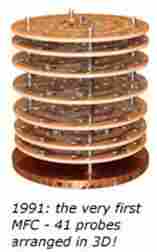
And thus the very first MFC came into being in 1991, in the form of a cumbersome barrel enclosing a spherical fixed array, its surface adorned with 41 probes arranged in 3D! A revolutionary concept that met the requirements but was costly and awkward to use.
MFC 3045: 全球标准
With the arrival of "short" magnets, developed notably by Picker in
the USA, to improve patient comfort, shimming became even more difficult. In
response to these changes, Metrolab developed 24-probe semicircular 2D arrays
that were made of foam-filled glass fibre composite, and rotated around an
axis. They appeared on the market in 1992 with the name MFC3035. Among the
problems they revealed were those related to normalisation of the probes (to
take into account small discrepancies between them); even today, MFCs must be
renormalized once per year, using a positioning device we call the "bed of
holes".
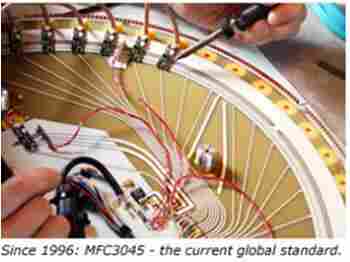
The concept was improved in 1996 with the development of a more robust chassis and connector technology. In addition to its three standard half-moons (400, 450 and 500 mm diameter), Metrolab used this as the basis for numerous customised geometries, either elliptical or with probes on the axis, with up to 32 probes. This second-generation technology, the MFC3045, continues to be the global standard for NMR mapping.
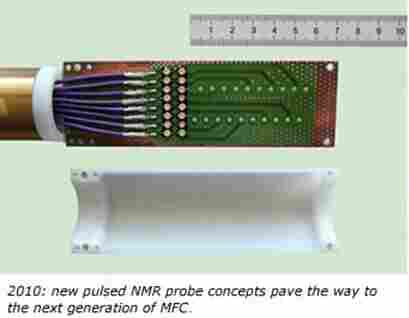
脉冲探头:未来的MFC
This could be about to change. Metrolab has been working for one year on new
pulsed NMR probe concepts, using the re-emission of energy at the NMR resonant
frequency – in contrast with the traditional continuous-wave probe, where the
absorption of energy at the NMR resonant frequency is used to obtain the
magnetic field value. "With this new
approach we can build much more compact probes, because the electronics are
separate," stresses Pascal Sommer. A key space-saving
improvement that paves the way to building MFCs geared to small MRI machines,
which are increasingly being used to diagnose hand and leg injuries and in
scientific experiments on small animals. The potential number of probes
operated in parallel will be practically unlimited: with the pulsed technique
each one is activated in succession at 10 ms intervals.
Another advantage of pulsed probes is that they break through the 7T barrier, which up to now had prevented MFCs from being used for very high-intensity instruments such as those operated at NeuroSpin. In general, "We obtain better performance levels at high fields with pulsed probes than with continuous-wave probes." The timing is perfect: the market is now shifting towards powerful magnets with intensities frequently in excess of 3T.
下一代的MFC基于脉冲探头,Metrolab公司的PT2026核磁共振高斯计就应用了这一功能。
北京华贺技术有限公司作为Metrolab在的代理与进口公司,全面支持其在的市场、销售和售后等服务。
