芯片上的三轴磁力计
By Philip Keller, Metrolab产品经理
瑞士Metrolab是精密磁力计的全球市场,在过去的30年中,已经赢得了大型物理实验室和磁共振成像的所有厂商的信赖。磁共振磁强计已经成为世界各地的物理学家,工程师和技术人员日常工具。常见的应用包括研究,磁体的制造和测试,标准和校准。
北京华贺技术有限公司作为Metrolab在的代理与进口公司,全面支持其在的市场、销售和售后等服务。
三轴霍尔磁力计是传统上意义上的高端测量仪器,但是设备复杂、笨重且昂贵。 芯片上的磁力计可以改变所有的问题,开辟全新的应用领域。
Hall effect devices are all around us today. Most are sensors such as magnetic switches, proximity sensors, and rotational sensors. In comparison, Hall magnetometers – whether for metrological or industrial monitoring applications – are a small niche. Nonetheless dozens of manufacturers offer such devices, with a wide range of size, performance and price. Three-axis Hall magnetometers, however, are rare, with fewer than 10 manufacturers. These instruments, which measure the complete magnetic field vector at a single point, offer the important advantage that the flux-density measurement is independent of the probe orientation.
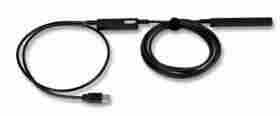
Compact three-axis Hall magnetometers have existed for many years (Figure 1), but most are high-end bench-top instruments – and correspondingly expensive. In some applications their utility is limited by the separation between the Bx, By and Bz sensors, typically in the order of several millimeters. Finally, when measuring arbitrarily oriented fields, rather than fields mostly perpendicular to the Hall sensor, the planar Hall effect becomes an important source of error.1
次革命
This picture has started to change in the past 15 years. The key development was the vertical Hall sensor, which, unlike the traditional planar Hall sensor, measures a field component in the semiconductor plane. Combining a planar with two vertical Hall sensors on the same chip results in an integrated three-axis Hall sensor. Compared with a traditional three-axis probe consisting of three discrete sensors glued to a cube, the integrated sensor simplifies construction and reduces the separation between the three sensors. Integrated sensors are typically only 100-200μm in diameter and 10μm thick, providing the closest thing available to vector measurement at a single point.
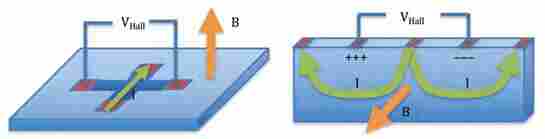
Of course there is a price to pay. To take advantage of modern IC manufacturing techniques, integrated sensors use a silicon substrate, which is not the best material for Hall sensors, and the sensitivity and noise figures suffer. In addition vertical Hall geometries are less favorable than planar ones.
But integrated sensors have other advantages. The same chip can also contain the input bias current source and output amplifier, thus tremendously simplifying the overall complexity of the magnetometer. An integrated temperature sensor – providing the temperature of the Hall sensor itself, where it really counts – enables the flux-density measurements to be effectively compensated for temperature drift.
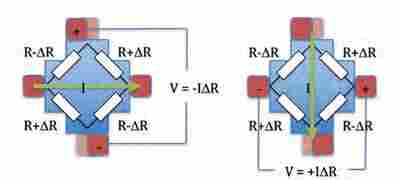
Finally, an integrated sensor makes it feasible to implement the so-called ‘spinning current’ technique , which minimizes common sources of zero-field offset, minimizes the planar Hall effect, and acts as a chopper to minimize 1/f noise.2
第二次革命
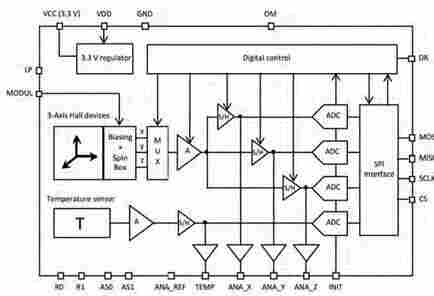
The first revolution produced a three-axis magnetometer on a chip – except that it is still an analog device. A logical next step is to integrate an onboard analog-to-digital converter (ADC) and digital interface circuit. In addition to reducing the system complexity even further, this approach also minimizes error voltages due to Faraday induction in the signal cables. A digital interface also makes it feasible to add many more controls, for example to trade off measurement rate against noise.
This latest generation of integrated three-axis Hall sensors, marketed under the name of MagVector MV2, is housed in a 3 x 3mm QFN package and enables the user to select an analog or serial peripheral interface (SPI) output. Despite its small size, it is a capable magnetometer with selectable ranges from 0.1-30T, a noise density of 300nT/√Hz, and an analog bandwidth of 50kHz. In digital mode, measurement rate can be traded against ADC resolution, ranging from 0.375-3kHz, and from 14-16bits, respectively.
典型应用
This magnetometer-on-a-chip enables applications that were formerly not feasible, due to the size, cost and sensor separation of a three-axis Hall magnetometer. Metrolab itself uses it in its latest generation of NMR magnetometers.3 Another typical application is an industrial field-mapping system. Traditionally such systems consist of a single Hall probe mounted on a mechanical scanning arm. Scanning the volume around a large magnet array can be extremely time-consuming. During the scan, the field map may change due to temperature drift. In addition, for cost reasons, a single-axis Hall magnetometer is often used, requiring complex, lengthy and error-prone computations to infer the missing field components.
In an industrial context, these constraints may not be acceptable. For example, magnetron sputtering systems use magnet arrays to help confine the plasma. Heat damage to these magnets can lead to uneven deposition, so it is increasingly common practice to map the magnets at regular intervals. Such a map can require hours of a technician’s time, during which the sputtering system is probably shut down, entailing a large loss of production.
An effective way to minimize these costs is to use an array of sensors, acquiring data in parallel and dramatically reducing the mapping time. In fact it may be possible to replace one of the scanning arm’s degrees of freedom with a sensor array, thereby also reducing the cost of the mechanical system. With a single-chip magnetometer this all becomes feasible.
It may seem that with this level of integration, anyone who knows how to use a soldering iron could build an inexpensive, top-flight three-axis magnetometer. That is not quite true. Being an electronic peripheral component, the MagVector MV2 includes none of the amenities of a traditional magnetometer; the user must supply the micro-controller, control firmware, host interface and user interface. In addition, calibrating the gain, offset, temperature coefficients, non-linearity and non-orthogonality of a three-axis Hall magnetometer requires sophisticated equipment and procedures. The cost and effort of such a development project must be carefully weighed against the cost and convenience of an off-the-shelf instrument.
结
The MagVector MV2 represents a logical
continuation of the evolution toward highly integrated three-axis Hall
magnetometers. Its size, performance and cost open new possibilities for
北京华贺技术有限公司作为Metrolab在的代理与进口公司,全面支持其在的市场、销售和售后等服务。
